Pass 01 · Retrieval
Read the delivery record
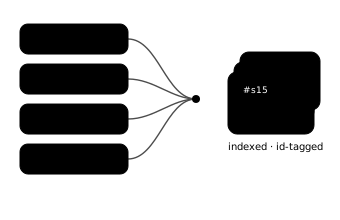
inJira · Confluence · Slack · RAID
outindexed artifacts + ids
Sprint Suite · Delivery intelligence
Sprintsight reads across Jira, Confluence, Slack and your RAID log, reconciles what each team claims against what its data actually shows, and names the teams reporting healthier than they are. Every verdict ships with its evidence.
Anatomy
It is the delivery term for a team that is green on the outside and red on the inside. Nobody set out to mislead. The status report is written from the narrative, and the narrative is always the last thing to change. Sprintsight cuts through and checks the two against each other.
Detection
Search-over-documents retrieves what a document says. Sprintsight reasons about the delivery process behind the documents. That difference is the whole product, and it shows up in three specific places.
TELL 01 · flat_burndown_vs_green
Scope is not moving across two sprints while the write-up says on track. Reading a burndown as a delivery signal, rather than as text, is what catches it.
TELL 02 · risk_in_chat_not_raid
A risk raised in a thread that never reached the log. Catching it needs an understanding of the RAID as a governance process, not just as a document to summarise.
TELL 03 · cross_team_dependency_slip
Atlas depends on Draco. Draco slips. Atlas's status is silent. The proof sits on both sides of a boundary that single-tool products never cross.
How it works
Sprintsight reads what your teams already produce. No new ceremony, no extra form, no change to how anyone works. Signals are computed deterministically, and thin data returns "insufficient evidence" rather than a guess.
Pass 01 · Retrieval
Pass 02 · Reconciliation

Pass 03 · Report writer
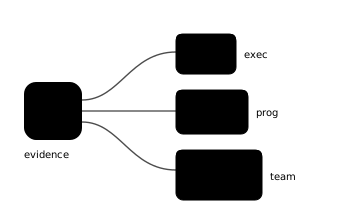
Why trust it
Telling a delivery director that a team is reporting inaccurately is a serious claim. So the detector is graded on two gates: did it get the call right, and did it cite the specific artifacts that prove it. Lucky guesses fail.
0/4
Classification accuracy
Correct verdict
0/4
Evidence accuracy
All required ids cited
100%
Citation coverage
No uncited claims
Pass
Fabrication gate
Declines on thin data
| Case | What it guards against | Reported | Assessed | Result |
|---|---|---|---|---|
| Atlas | The one it must never miss. A false negative here is the worst possible failure. | Green | Red | ✓ watermelon |
| Boreas | A genuinely healthy team. Flagging it would be a precision failure. | Green | Green | ✓ not flagged |
| Cygnus | Honest amber. Reports its problems openly, so it is not a watermelon. | Amber | Amber | ✓ not flagged |
| Draco | The decoy. An alarming bug spike that is actually triaged and under control. | Amber | Amber | ✓ not flagged |
Coming soon
Sprintsight is in build and opens on sprintsuite.uk. Leave your email and we'll tell you the day it launches, with early access for Sprint Suite users.
No marketing list. One email at launch.